sermon

The Newer Testament

Introduction to the theme

We are following a programme called Holy Habits over the course of this year. The programme studies 10 aspects of life in the early church. The early years of the church were characterised spiritual renewal, incredible dynamism and above all growth. These appear to be lacking in contemporary Western Christianity and the the hope is that by recapturing some of the habits of the early church we may also to be able to reinvigorate ourselves with some of that dynamism. We are asked to study how the early church lived and contrast it with how we live today. If what we do differs form what the early church did then we are invited whether there is a better way for us to live now. This month we have been thinking about scripture in this context. Did the early church relate to scripture in a different way to how we do today?

The answer is an answer of two halves – the Old Testament and the New Testament. As far as I can see the attitude of the early church to the Old Testament is very similar to ours today. They saw it as a sacred document that had been written in the past collating a wide range of literature that was regarded as the primary record of how their ancestors had experienced God. The relationship with the New Testament was entirely different to ours. Put most succinctly – while we read the New Testament the early church wrote it.

I’m at a bit of a disadvantage preaching in the fifth of this series of services as for one reason or another I’ve not been present for any of the previous four. I’m not sure what the other preachers have covered but I assume that there has been some reflection on how the Bible was written. There have been considerable advances in our understanding of this in theological colleges over the last fifty years, and it sometimes surprises me how little of this understanding has been passed on to congregations. At least some of it is finally filtering through. To recap:

No one set out to write the New Testament – in a sense it just happened. It is a collection of letters of early church leaders, accounts of activities of both Jesus (the Gospels) and the leaders of the early church (Acts) and a book of apocalyptic poetry (Revelation).

What we know of how the Bible was written is largely inspired guesswork. While there is general agreement amongst biblical scholars on the general principles,very little of the detail is known for certain and different scholars, at times, hold quite radically different views about those details.

There is general agreement that the letters (particularly those attributed to Paul) were the first documents to be written. We can guess the dates of these by correlating what is written with the stories of Paul’s journey’s in Acts. First Thessalonians may have been the first to be written but was still written about 20 years after Jesus’ death. The other letters from Paul were probably written over the ensuing 10 to 15 years. As I’ve said they were not written in order to become part of the Bible they were written in a particular context generally to support the growth of churches Paul had established and then moved on from. they are a mix of thanks and encouragement for the good things that Paul has heard about their acts and chastisement for the bad things.

It looks as if stories about Jesus’ life circulated in the early church by world of mouth and were only collated into what we now know as the gospels much later on. Mark is regarded as the earliest but appears to make references to the Roman destruction of Jerusalem and of the Temple so cannot have been committed to paper (or papyrus) before 70 AD. The others probably followed in later decades. Recent scholarship shows how many of the stories we read as prose today where written as quite exquisite poetry and have obviously been amended and polished as part of this process but nobody knows when or by who.

The other letters in the Bible (Peter, John, James and several others) were written later. 2nd Peter which may have been written as late as 120AD. Somewhere in the middle of this the Book of Revelation, which is quite different to anything else in the New Testament was written. Acts of the Apostles was also added as a history of the early church after Jesus’ death and resurrection.

The other thing that modern scholarship has taught us is that what we know as the New Testament is just a small selection of documents that were revered by the early church. We now know of the existence of over 50 Gospels including a gospel of Thomas and of Mary. There were also many other letters including a third letter of the Corinthians, a letter form the Corinthians and letters of later church leaders such as St Clement. There were other records of miracle stories and other apocalyptic visions.

There was quite a long period where different churches in different regions revered different texts. It was probably sometime in the 3rd century that a consensus began to emerge on which of these were most important but it was not until 367 that we have the first record of the 27 books we accept today. It was until after the reformation that an official list was declared.

So there you are the Bible is now closed. It is not particularly clear when it was closed but it was an awful long time ago. What I want to explore this morning is what  Christianity would be like today if the Bible had not been closed, if we had continued to add to it, if we were still adding to it today. If we are to live as the early church lived, as our Holy Habits programme would suggest, then we should be continuing to write scripture. Let’s assume that as well as an Old Testament and a New Testament that there was also a Newer Testament then what would we include within it?

Following the early church it would be made of a variety of documents. None of the books of the Bible were written with the intention of becoming the Bible so we need documents that have been written for other purposes. We need to scavenge around for documents from a range of sources which we believe inspire, encourage of correct us. It’s clear that only a small number of people actually wrote these documents so we should perhaps be looking for pieces that other people have written. The Bible includes history,. poetry, religious songs, letters, visions and prophesy (at least) so we should look for literature of range of different types. At the time the early church was living the only option to record anything was to write it down but now we could include music or video or pictures of works of art. Above all we wouldn’t put it in a book would we we’d put it on the Internet. This opens up a wonderful possibility of the Newer Testament changing over time to reflect the world we live in. New material would continue to be added and older material, if it was felt to be losing relevance could be deleted.

Following the early church we would collate a wide range of articles that appealed to a wide range of people. Having done this, however, we would sift through this as a group to select the items that spoke most powerfully to the Christian community as a whole.

Have a think. Reflect on what you have read over the last couple of years, or heard on the television or he radio, or seen in an art gallery or stumbled across on the Internet. Of all that rich experience, which items would you propose for the Newer Testament. Do more than think, e-mail me your ideas and I’ll collate the suggestions for the Church web-site. If you are savvy with a computer then cut and paste links and send them to me. If you are not then leave a message on my answering machine and I’ll pop around and make a copy of what you have to offer. Try and keep things recent and I suggest limiting passages to something that can be read in three or four minutes at most. Other than that break free -there are no rules – there don’t appear to have been any particular rules in the early church.

To get you started here is a piece I would include. It is a video from Meg Cannon a young Christian woman telling the story of an even younger African girl. To me it merges the telling of a story as in one of the gospels or Old Testament history with the sense of inspiration and urgency that we find in many of Paul’s letters.

Hymn

Enemy of Apathy is one of the range of modern hymns that I would add to the Newer Testament. You can here a clip of it at this link (though I’m not sure how legit this is).

Readings

Rather than select two Bible readings I’ve chosen an excerpt from the Pope’s speech to the United Nations General Assembly in 2015 (full text here) which is another document I might submit for the Newer Testament.

First, it must be stated that a true “right of the environment” does exist, for two reasons. First, because we human beings are part of the environment. We live in communion with it, since the environment itself entails ethical limits which human activity must acknowledge and respect. Man, for all his remarkable gifts, which “are signs of a uniqueness which transcends the spheres of physics and biology”, is at the same time a part of these spheres. He possesses a body shaped by physical, chemical and biological elements, and can only survive and develop if the ecological environment is favourable. Any harm done to the environment, therefore, is harm done to humanity. Second, because every creature, particularly a living creature, has an intrinsic value, in its existence, its life, its beauty and its interdependence with other creatures. We Christians, together with the other monotheistic religions, believe that the universe is the fruit of a loving decision by the Creator, who permits man respectfully to use creation for the good of his fellow men and for the glory of the Creator; he is not authorized to abuse it, much less to destroy it. In all religions, the environment is a fundamental good.

The misuse and destruction of the environment are also accompanied by a relentless process of exclusion. In effect, a selfish and boundless thirst for power and material prosperity leads both to the misuse of available natural resources and to the exclusion of the weak and disadvantaged, either because they are differently abled (handicapped), or because they lack adequate information and technical expertise, or are incapable of decisive political action. Economic and social exclusion is a complete denial of human fraternity and a grave offense against human rights and the environment. The poorest are those who suffer most from such offenses, for three serious reasons: they are cast off by society, forced to live off what is discarded and suffer unjustly from the abuse of the environment. They are part of today’s widespread and quietly growing “culture of waste”.

and the second reading is an example of something that is written in the Bible but I believe requires very cautious interpretation in the modern world:

2: 1 Corinthians 14:34 and 35.

34 Women should remain silent in the churches. They are not allowed to speak, but must be in submission, as the law says. 35 If they want to inquire about something, they should ask their own husbands at home; for it is disgraceful for a woman to speak in the church.

Sermon

I think everything I talked about earlier in the service, the history of how the Bible was written by the early church, is pretty much accepted by most theologians. There may still be debate about details but generally speaking we now have a reasonable picture of how the Bible, particularly the New Testament, was written. It was written by a variety of people writing for a variety of different purposes, but none of them, as far as we know, was intending to write a book of the Bible.

If the Church, or at least its theologians, has come to accept this view, however, I’m not convinced that it has yet faced up to the implications. For most of the life of the Church there has been an assumption that the Bible is the infallible word of God – a belief that every word that has been written in the Bible must take equal weight and that the messages its conveys are valid for all time. Our current understanding of how the Bible was written must challenge that view. The Bible may be inspired by God (as the Bible itself claims in the 2nd letter to Timothy) but it was written by men (and we should note is was written by men, there is no evidence of any female involvement in the writing of any of the books of the Bible). It was written by men who were struggling to come to terms with how God was manifested in their lives. It had its origins in the memories of disciples who had lived through the pain of the Jesus’ execution, who had experienced something completely beyond their understanding in the resurrection, and were now inspired and emboldened by a new power in their lives. They were struggling to understand what all this meant and the writings that now form the New Testament are the record of that struggle. When we read what they wrote we have to read it with this understanding of how it was written.

We also need to remember that these men were products of their time. They had a very different worldview to the one we have today. Paul was brought up a strict Jew and trained as a Rabbi. He had only ever experienced worship in which the men stood at the front and worshipped and the women stood at the back and watched. Paul had clearly never met a woman like Meg Cannon, a women with uncovered hair and a message as powerful as that of any man. Similarly, the early church just assumed that slavery was a part of the natural order. When Paul instructed a runaway slave to return to his master in Philemon it was because he could not conceive of the world being any other way. Going further it is virtually certain that Paul had never met a gay or lesbian person in a committed, faithful and loving relationship. The only homosexual practices he had any knowledge of where those of the e prostitutes in a variety of pagan temples in the ports around the Eastern Mediterranean.

We also need to read the Gospels with an understanding of who wrote them and when. They were written by men who didn’t distinguish between religious poetry and fact-based journalism in the way we do today. If we are concerned that we are moving in the current world into a post-factual era we should remember that the New Testament was written in a pre-factual era. The Gospels were also written by men who had no understanding whatsoever that the way the world behaves is governed by the immutable laws of physics, chemistry and biology. They lived in a society in which people were far more willing to believe in a miraculous happenings and supernatural explanations than we are today. Their purpose wasn’t to write historically and scientifically verifiable journalism, it was to embed the truth of their lived religious experiences in the words that would best convey this to their contemporaries.

I don’t see that any of this would be a problem if the Bible had remained open (as far as writing is concerned) but it didn’t, it was closed in  practical sense about 150 years after Jesus’ death. It means that the only scripture we acknowledge today was written by people with very different world-views to ours.

The way the church has got around this over the years is to invent theology. This means that we read one thing in the Bible and then we interpret in the light both of our understanding of how the Bible was written and of our knowledge from other spheres. Thus although the Bible remains constant and unchanging how we interpret it has developed considerably over time.

For centuries references to slavery within the Old Testament and Paul’s letter to Philemon reinforced the general view that slavery was an inevitable consequence of how society was structured. It wasn’t really until the Enlightenment and the emergence of the concept of the human rights of all individuals that this began to be questioned. As with many societal changes, the church was quite slow to respond but eventually Christians came to realise that slavery is an abomination in the eyes of God and to campaign for its abolition. No one in today’s church would follow Paul in advising an escaped slave to return to his master.

Attitudes to women within society have changed and the churches theology has followed. We now recognise that Paul wrote at a particular time, in a particular context and from a particular background. Very few people within our denomination are now prepared to take what he wrote in Corinthians at face value and it continues to be a source of considerable pain that our Carholic brothers and sisters (and to a lesser extent the Anglicans as well) continue to struggle with these passages.

So how do we deal with these issues? At one level the sensible approach is to continue what the church has always done and develop a theological framework through which we can interpret the Bible in the light of our current worldview. I’m not however, convinced that this is enough. It satisfies us within the church, but it is extremely confusing to those outside the Church. They see us revering the Bible as the word of God and then choosing to reinterpret those sections that we don’t like. although some people do,  I would be extremely unwilling to give a non-Christian a Bible and just leave them to read it. Whilst we do hear some stories of people doing this and individuals coming to faith I’m sure that a much more common response, in the modern world, is for people to be put-off by what they find written in its pages. Imagine giving a Bible to a non-Christian woman and her opening at random to read the words of Paul we have heard read out this morning.

So is there an alternative. I think there is, or rather that there are things we can do as well. What we can do, as well as revering the Bible, is to revere contemporary writings and video and music and art that speaks to us of our ongoing relationship with God. I think we should revere videos like those produced by Meg Cannon, I think we should revere the rich variety of modern Christian songs whether they be from the Iona Community or the Rend Collective, I think we should revere the speeches that made by our leaders to make take the Christian message to the contemporary world.

So this morning I encourage you all to think about what you think we should revere in the contemporary world. Which writings and songs and art works speak most powerfully to you of your relationship with God? The idea of collating this material on a web-site is of course a bit of a gimmick, but I hope that it is the sort of gimmick that will get you thinking and change the way you look at the world.

John saw Christ as the Word. Let’s see the Word of God not as something that was entombed within the Bible 2,000 years ago but as the living Word unleashed through the Resurrection to speak to all people for all time.

Eating Together

Our Church has adopted the Holy Habits programme  for this year and will be looking at one of the ten themes each month. This month the theme is Eating Together and all preachers have been asked to follow the theme.

holy-habits

This sermon is based around the parable of the Great Banquet (Luke 14) and also draws on the story of Abraham’s hospitality (Genesis 18:1-8). It was preceded by the worship song Come to the banquet, there’s a place for you and followed by another Walls, mark out boundaries, both of which I learned whilst living in Australia.

Out theme for this month has been “Eating together” and so far the focus has been on eating and on food. This morning I’d like us to focus on the “together” bit. Who, as Christians, should we be eating together with?

Earlier on a retold the parable of the Great Banquet. At face value that parable is about food, about who to invite to a feast. Except of course it isn’t really is it? It’s allegorical – an extended metaphor. The story isn’t really about a banquet, it is about the Kingdom of God. It’s not really about the rich man’s friends, it’s about a religious establishment that pays lip service to God love but then ignores him  when he challenges them to take action.  It’s not really about the poor and starving town’s people, it’s about those who are seen as outside the religious establishment but truly understand what it would be like to be loved by God, people who have never been invited to share that love in terms that are meaningful to them.

The older I get the more and more important I consider this parable to be. I have no memory of it being given any particular emphasis in my earlier experiences of faith. I can remember being taught about the parables of the Prodigal Son, or the Lost Sheep, or the Good Samaritan. I remember being taught about the miracles and healing acts of Jesus, but I don’t remember this particular parable making any particular impact on me until my time in Australia. There it was foundational to the ministry of the Uniting Church minister who happened to be at the church that we joined. I don’t remember him preaching about it specifically, but I do remember the two songs that we sang on many occasions – the one we sung earlier and the other that we will sing after this sermon. Since that experience this parable has shot up the league table of important passages within the Bible in my mind and now maintains a place pretty near the top.

Its power, as in so many of the parables, comes from its allegorical nature. As I’ve said it is not really a story about food. It is about how we view religion. In Jesus’ day religion was defined by the observance of a number of religious practices – only eating certain foods, washing yourself in a particular way before eating, saying prayers at a particular time in a particular way. Those who observed these rules saw themselves as righteous and assumed they would inherit the Kingdom of God. When a group starts to identify itself as righteous, of course, it will automatically start to identify everyone else as unrighteous and this is what had happened by the time Jesus came along.

But of course we are often guilty of this ourselves both superficially and at a much deeper level. We tend to assume that the church is composed of that group of people that want to come to church for an hour on Sunday mornings and sing hymns and say prayers and drink cups of tea or coffee afterwards don’t we? If people don’t want to do that then we’re at a bit of a loss to know what to do with them aren’t we? What would you do with someone who said I want to learn how to love Jesus but I’m not particularly keen on singing hymns or sitting still?

At a deeper level protestant theology is rooted in the division of people into those who have been saved and those who haven’t. More aggressive Protestants tend to assume that it is obvious which is which, more generous ones may admit that this may not be so clear. But most of us here, deep within our religious psyche, hold to an assumption that God’s salvation is restricted to a certain number of people. Many of us can be rather lazy and put these two concepts together and assume that the saved are those that want to come to church and sing hymns and share a cup of tea afterwards. If we are even lazier we extend this to the assumption that those who do not want to live like this are the unsaved.

When we read the story of the Great Banquet and remember the context in which it was told then we often appreciate the absurdity of how those within Judaism in Jesus day viewed the world. What’s really important though, and what makes this story so relevant to the modern world, is that it should also alert us to what is absurd in how we view the world. It tells us that we need a broader view than we have at present of where value lies in this world. We need to move away from the assumption that all that God values in the world is tied up in the church and those who choose to attend. We need to open ourselves to the truth that there is much of value within this world that lies outside these doors, both literally and metaphorically.

One of the issues that came up in our house group the other day was that of how we relate to the spouses and families of many of our church members who choose not to come to church themselves. Maybe a theology that seeks out the good in anyone, whether they identify themselves as Christian or not, provides a basis for such a ministry. How this works out practically isn’t clear in my mind but maybe just thinking in this way might open doors.

Going back to our Bible story though we may get clues. Jesus clearly spent considerable time eating with this disciples, he also spent considerable time eating with other people as well. The context of this story is a meal at a prominent pharisee’s house. Jesus has chosen to dine with someone with whom he disagrees quite fundamentally. Not only this, but we are told explicitly that Jesus was being “carefully watched”. He has chosen to dine with someone who is suspicious of him, who is spying on him, who may be plotting against him. The first lesson we can learn from this story is that when we talk about eating together we need to think about eating together with others as well as eating together amongst ourselves. The heavenly banquet is laid out for all people, not just for us; however we choose to define “us”.

But Jesus goes further than this he chooses not only to dine with others but to talk seriously with them about things that matter. He goes into a potentially hostile situation and presents his vision of the world. We’ve got a convention in Britain haven’t we that at a dinner party the conversation should steer clear of sex, politics or religion. Even if we regard such formal guidance as a little old-fashioned, a lot of our conversations, when dining out, particularly with people we may not know so well, do tend to the superficial and ignore the issues that really matter. Jesus is demonstrating the opposite, he is choosing not only to dine with people who have different views to him but to engage in a meaningful conversation with them. He is choosing topics that might bring about a difference of opinion, that might challenge. Indeed we can go further, he is choosing topics that will bring about a difference of opinion, that will challenge. He is doing his hosts the honour of taking them seriously, of talking about things that matter rather than the merely superficial.

For want of a concrete example of this I want to turn the tables on their heads and tell of a time when I was invited to a meal by people of another faith. It was shortly after the September 11th attacks in 2001. We had been living in Melbourne for just over a year. As in so much of the world there had been a wave of anti-muslim feeling. In response the Islamic community in Melbourne chose to invite people from the local churches to share with them in their Iftar feast. Most of us think of Ramadan as a time of fasting but the fast is only for daylight hours and on the evening after the sun has set the tradition is for Muslim families to share a celebratory meal called Iftar.

So I drove across Melbourne to large house in the northwest suburbs. There I met a muslim family and small group of Christians drawn from from across the city. A young woman welcomed us in and made us welcome. She told us about the feast and how it is a Muslim characteristic to be hospitable. She traced this back to the example in the Quran of Abraham who invited three strangers into his house, the story we have read earlier from our scriptures this morning. We started the meal with a date – apparently it is not good to break the fast to quickly, and then moved on to more substantial fare. Having shared some of her tradition with us and something of the fear that her community had for the future, she invited us to tell stories of our traditions and to share our hopes and fears for our communities. Over the meal we talked of things that mattered. We learned to understand, we made friends with people we had never met.

I left that meal in a state of grace. I remember driving back through the dark with a feeling of elation and filled with the spirit. We had some special experiences in the nine years we were in Melbourne but I don’t think there was a night when my heart was moved as much as it was that night. I felt truly blessed.

So let’s not just think this month about what we can and should eat. Let’s not just use it as an excuse to dine with old friends. Let’s look around us and see if there is anyone we can invite to our table as an act of outreach and mission. Let’s look out for people in  our community who are different to us and who might disagree with what we think. Let’s look for opportunities to invite them to a table to talk about things that matter, to seek what is of value in their lives as well as expressing what is of value in ours. Who knows? God’s grace may settle on our table in the same way it did on the table I dined at on that evening fifteen years ago on the other side of the planet.

What is the role of the church at a time of national turmoil?

This sermon was preached about 10 days after the UK voted to leave the European Union – Brexit as it is now called. It is based on Galatians 6:1-10.

I’ve been invited here to talk about Christian Aid and I will, but only later in this sermon. I don’t think I can stand up in a pulpit this morning and not say something about the situation that our own country is in at the moment. We seem to be in a complete mess don’t we?

brexit-1485004_960_720

The trigger for this mess has been the referendum. One side clearly got more votes than the other, but only by a small margin. The conclusion of the referendum shouldn’t really be that there is agreement within the electorate about the way forward for our country. The conclusion should be that there is disagreement about the way forward. Whilst it is clear that the leave campaign got the largest proportion of the votes in an election that triggered the highest turnout in recent political history. It is perhaps important to remember that they won 37% of the votes of the total electorate to the Remain campaign’s 35%. We are a nation divided.

Following this  there has been turmoil on the financial markets. The pound crashed and hasn’t recovered. Nearly 2 trillion pounds was wiped off the value of the stock market we are told. This hasn’t lasted. The FTSE index has now bounced back to well above the pre-referendum result. What does it all mean?

Perhaps most obviously at the moment there is a lack of consent over the leadership of our two main political parties. Present indications suggest that Theresa May will become leader of the conservatives and prime minister. This will leave someone who felt it was in the UK’s best interests to remain in the EU to lead the country through the process when we leave. How can that make sense? In retrospect it seems a bizarre that the referendum was conducted that has allowed the people to vote for a policy that none of the major political parties believes in.

And what of the 30,000 people yesterday who marched through London in favour of the EU? Are they anti-democratic in fighting against the result of a fair referendum  – or is there justification that the referendum was fought on a number of lies and promises that the major leave campaigners have now reneged on once the votes have been cast?

I started off by declaring that we are in a mess and this seems to be the one thing, perhaps the only thing, that we can concluded with certainty from the events of the last 10 days. But we’re a church, we’re in an act of Christian Worship. What is the role of the church? What is our role as Christians at a time of political crisis?

The Methodist Church has combined with the Baptists, URC and Church of Scotland to form the Joint Public Issues Team. The Team aims to enable our four Churches to work together in living out the gospel of Christ in the Church and in wider society. We aim to promote equality and justice by influencing those in power and by energising and supporting local congregations.

It published a booklet “Think, Pray, Vote” to guide its church members through the issues of the referendum campaign. That booklet takes as its starting point the “new commandments” of Jesus that we should Love the Lord our God with all our hearts, souls and minds and love our neighbours as ourselves”. It goes on to suggest that for Christians the question underpinning the referendum should have been “To what extent does the European Union enhance or hinder our ability to love our neighbour and, in doing so, our ability to love God?”

There are two consequences of this approach which I want to focus on. The first is the implication here that, as Christians we should be voting for the option that gives us the best opportunity to love our neighbour. Our vote should not be cast for what we want, it should be cast for what God wants. This made the referendum very difficult because both sides were campaigning incessantly on what would be best for us and not exploring what would be best for our neighbour. An example would be the discussion of the money that we pay into the EU each week (whether it be £350 million or £120 million). We heard a lot of money about who gives it (us) but very little about who receives it (those areas of the EU who are much less well off than we are).

But the other thing that is important about the Church’s response is that it doesn’t advocate a particular policy. It acknowledges that the issues and political environment are complex and that, whilst Christians may agree in the overall aim, there might be differences of opinion amongst Christians in how to achieve it. The role of the church is to remind us of the values we hold as important and to place those at the forefront of our decision making.

This is essentially the message of the passage we have heard from Galatians this morning. The passage asks us to remind each other of God’s purpose. It places a particular burden on us to do this at times when we fear that others may have been misguided, but it also reminds us that we should continually test and re-test our own actions. It reminds us that if we sow to please the Spirit then from the Spirit we will reap eternal life. Finally it concludes “Therefore, as we have opportunity, let us do good to all people”.

You may feel that there is little you can do to influence the national debate but the nation is comprised of individuals, that is the essential truth that is acknowledge by any referendum and it is essential that we do what we can. In the coming weeks I ask you to go into your communities, to talk to friends and colleagues and families and to remind them of the values that we as Christians hold dear. Don’t necessarily get drawn into fierce political arguments but do remind others that we want a society that places the needs of our neighbours (however we define them) as more important than our own.

Which brings me back to Christian aid. Christian Aid is an organisation which has been doing exactly this for more than 70 years now. It has been promoting Christian values of compassion, justice and love to the British population. It does propose solutions and it does advocate policy but above all it reminds people of the centrality of Jesus commandment that we love our neighbour. The theme for this year has been “Love every neighbour”.

The house to house collection in Christian Aid week is the biggest single act of Christian witness in the UK every year. It is not just offering people an opportunity to donate money, it is placing before them a vision of the Kingdom of Heaven in which the poor shall be valued and the hungry fed. It is placing our values at the heart of the national debate. And it works, one of the things that we should acknowledge, whatever we think of our outgoing prime minister is that he has fought hard to increase, sustain and protect the overseas aid budget of this country. That wouldn’t be possible without the campaigning work of Christian and secular aid agencies working together to remind us all who our neighbours are.

So on behalf of Christian Aid I thank you for the support you have given us in the past. We are particularly thankful for the work of individuals like Bob but we are also thankful for the commitment of anyone who has supported our work in whatever way.

I want to end by re-inviting you to share Christian Aid’s mission in your own lives. I invite you to pray, particularly over the coming weeks of political turmoil, to be reminded of who your neighbour is and how you can express your love for them. Try not to get pulled into the nastiness of partisan political debate. Try instead to focus on a vision of God’s Kingdom in which the hungry are fed, the naked clothed and the sick cared for. Our role as Christians is to hold up these values as our gift to the world and to pray that others receive that gift and work with us towards bringing that Kingdom to fruition.

Thy Kingdom come, thy will be done, on earth, as it is in heaven.

A question of sovereignty

This sermon was preached about two weeks before the Brexit vote (although it has been posted since then and in knowledge of the result I’ve not changed what I wrote originally). It was preached as as  series of three mini-sermons each based on a different Bible passage of which I’ve quoted a few verses. In between I’ve placed links to videos of the hymns I chose.

brexit-1462470592zsa

Introduction

In the last days the mountain of the Lord’s temple will be established  as the highest of the mountains; it will be exalted above the hills,  and peoples will stream to it.  Many nations will come and say,

“Come, let us go up to the mountain of the Lord,  to the temple of the God of Jacob.He will teach us his ways,  so that we may walk in his paths. The law will go out from Zion,  the word of the Lord from Jerusalem”.

From Micah 4:1-4.

June 23rd fill present us with the biggest political decision facing the country in a generation. Should we leave or stay in the EU? This is difficult to preach about. I don’t think there is a “Christian” view of whether we should leave or stay. I am sure there will be a diversity of opinion within congregation, there certainly is within the community and within the country. I’ll be quite honest, I’ve got a very clear view of which way I’m going to vote. That view will almost certainly be shared enthusiastically by some of you and vehemently opposed by others. My purpose this morning is not to abuse my position in this pulpit by trying to persuade you to my point of view but to ask what Christianity has to say about the issues.

Just because I don’t believe that there is a Christian view on the way we should vote doesn’t mean that I don’t believe the church has got anything to say. I do believe that there is a strong Christian view on what the issues are, or at the very least what they should be. I think as Christians together we should be able to agree on what those issues are, even if, as individuals, we have different opinions about whether remaining or leaving is the best option to address them.

I went to a session put on by Churches together in Poynton last week which was attended by Edwina Curry amongst others. Although there were representatives from both campaigns present, the main activity of the evening was for the audience to sit around tables and talk to each other. Around our table, as around all tables, there was a wide diversity of opinion. But what really helped us to share a meaningful conversation was being asked first of all us to identify what the issues were and only then to have a discussion about whether these would be better addressed by being inside or outside the EU. It worked very well and there was a depth of debate that went far beyond the superficial squabbling and name calling that seems to have characterised the national debate.

A significant part of the debate has been about sovereignty. The Leave side think that our country should have sovereignty – it should retain the authority to make decisions for itself. In many ways they would see that this is what defines a modern state. The Remain campaign believes that, by pooling certain aspects of decision making power with other countries, we can achieve more than any country could do individually. There are very different views about who should be in control.

Most Christians, however, would believe that in some sense God should be in control. I don’t think that it is good theology for us to want to claim sovereignty for ourselves. We believe that sovereignty rests with God. It is God who decides what is right and it is then our responsibility to try and work to bring about God’s will. This is the vision that is placed in front of us in this reading from Micah. He will teach us his ways,  so that we may walk in his paths.

Let us listen to God and what he wants because it is only when we have done this that we will be able to walk in his path. For Christians the issue should not be about whether power rests in Westminster or in Brussels but which is more likely to bring about God’s will.

So having established this as the overall question that Christians need to consider in preparation for the referendum I want to look a three specific issues, Peace, Prosperity and Poverty.

Peace

He will judge between many peoples  and will settle disputes for strong nations far and wide.
They will beat their swords into ploughshares and their spears into pruning hooks.
Nation will not take up sword against nation, nor will they train for war anymore.
Everyone will sit under their own vine and under their own fig tree,
and no one will make them afraid, for the Lord Almighty has spoken.

From Micah 4:1-4

 God wants us to live in peace. The passage we’ve just heard read is one of the most powerful in the whole of the Bible. Nation will not take up sword against nation, nor will they train for war anymore.

One of the first things we have to remember about the EU is that it was born out of a continent which had been ravaged by war for centuries and had just emerged from being at the epicentre of the two most savage wars in history. I’m too young to remember the Second World War and the absolute mess that Europe was in at the end of it but some of you may just remember.

The foundation of the EU was a direct response to this and almost literally a working out of the injunction to beat swords into ploughshares and spears into pruning hooks in that it started with European Coal and Steel Community. The factories that had been used to produced ammunitions were being converted to building the infrastructure required for peace. It is no coincidence that shortly after that there emerged the foundation of the Common Agricultural Policy to ensure that there was enough food to eat and that farmers were adequately paid for this whilst prices were kept low enough for people to afford. The ploughshares and pruning hooks were forged.

There can be no real doubt that the EU has been successful in this. It is absolutely inconceivable – to me – that Europe will ever have another war on the scale of those of the last century. We have learnt to live together, to grow food together, to trade together. The role of the EU in building and consolidating peace in Europe has been recognised by the Nobel prize committee who awarded the Peace Prize to the whole of the EU in 2012.

But just because the EU has had such a strong role in establishing peace in the past doesn’t necessarily mean that it is best served to consolidate that peace in the future. There is a strong argument that, in relation to establishing peace, that the EU has done its job, that that process is essentially complete, that war between nations within Europe is inconceivable.

The threats to our security have changed. They no longer come from aggressor nations within Europe. They come from unstable nations beyond Europe and through how this spills into Europe through the action of various terrorist groups. Often this is inflamed by fundamentalist religions but it is also deeply rooted in the inequality of power and wealth distribution across the planet.

It is not obvious to me – at any level of detail. Whether remaining in or leaving the EU is more likely to consolidate peace in Europe. Reducing border controls undoubtedly makes it easier for terrorists to travel, but increased cooperation between nations in gathering information for security purposes is presumably our most effective weapon in fighting this. How these balance out in reality I’m just not qualified to judge, but I do think that as Christians one of the first questions we should be asking in this referendum is which choice is going to do the most to promote peace across Europe.

Make me a channel of your peace

Prosperity

In the name of the Lord Jesus Christ, we command you, brothers and sisters, to keep away from every believer who is idle and disruptive and does not live according to the teaching[a] you received from us. For you yourselves know how you ought to follow our example. We were not idle when we were with you, nor did we eat anyone’s food without paying for it. On the contrary, we worked night and day, laboring and toiling so that we would not be a burden to any of you. We did this, not because we do not have the right to such help, but in order to offer ourselves as a model for you to imitate. For even when we were with you, we gave you this rule: “The one who is unwilling to work shall not eat.”

We hear that some among you are idle and disruptive. They are not busy; they are busybodies.  Such people we command and urge in the Lord Jesus Christ to settle down and earn the food they eat.

2 Thessalonians 3:6-12

Much of the debate about the EU is economic. The fundamental question we are faced with is whether the country will be more prosperous within or outside the EU. The leave campaign believe that by withdrawing we will stop having to make payments to the EU and that we will be left in a stronger position to trade with partners outside the EU. The leave campaign think that the economy will suffer if we reduce our links with Europe and that tax revenue lost will be greater than the contributions we make at present. Both sides are coming up with ludicrously exaggerated claims about what would happen if the other side won. Both sides are clearly exaggerating how the economy might respond to a decision either way.

The Biblical perspective on prosperity is an interesting one. At one level it is grounded and realistic. It is quite clear that no-one is owed a living and that we should all expect to pay our way. This is clear from the words we’ve just heard from Paul’s letter to the Thessalonians.  we worked night and day, laboring and toiling so that we would not be a burden to any of you. We did this, not because we do not have the right to such help, but in order to offer ourselves as a model for you to imitate. Several of Jesus parables clearly suggest that we should be using our talents to generate income and provide for ourselves.

On the other hand there are many more passages in the Bible and particularly in the teaching of Jesus, where the dangers of becoming obsessed by wealth are spelled out. The most obvious is the story of the rich young man who asked what he must do to gain eternal life and was told to give away all he possessed. On balance the Christian position is that we should expect to work to ensure we have enough to live on but should not make accumulating wealth the driving motivation in our lives.

In the context of the current debate we should perhaps remind ourselves that the UK is the fifth biggest economy on the planet. We tend to hide this from ourselves by our obsession with growth. It is true that the economy isn’t growing at the moment but we shouldn’t let this obscure the fact that we are still, as a nation exceedingly wealthy. Being inside or outside the EU may make a small difference to just how that wealth develops in the future but the decision either way is unlikely to affect our basic position as one of the wealthiest countries in the world.

If we take a biblical position on wealth we should be thankful for the wealth we have. We should accept that this wealth is a product of our industry in the past and strive to be productive in the future. But we should not let allow our obsession with wealth creation to become the sole focus of the debate.

If there is one contribution that I think Christianity can make to the present debate(in relation to the EU and more widely) it is to ask politicians to focus less on how we create more wealth and more on how we use the wealth we already have to create a society that is more reflective of God’s Kingdom. It’s a debate that we have heard almost nothing about from either side in this referendum campaign.

For the fruits of our creation

Poverty

“My soul glorifies the Lord and my spirit rejoices in God my Saviour,  for he has been mindful  of the humble state of his servant. From now on all generations will call me blessed, for the Mighty One has done great things for me— holy is his name.

His mercy extends to those who fear him, from generation to generation.

He has performed mighty deeds with his arm; he has scattered those who are proud in their inmost thoughts.

He has brought down rulers from their thrones  but has lifted up the humble.

He has filled the hungry with good things  but has sent the rich away empty.

He has helped his servant Israel, remembering to be merciful to Abraham and his descendants forever,  just as he promised our ancestors.”

Luke 1:46-55

I often preach from the lectionary, from the list of Bible readings set for each week. I’ve not done that this week, clearly a list of readings on a three year cycle is not a good framework for thinking about an issue like the EU referendum which only occurs once in a generation. When I do stray from the lectionary I find that the Magnificat is a passage that I want to preach from more and more.

It’s a revolutionary vision of god’s Kingdom sung by a pregnant young woman. Mary is feeling God’s potential growing inside her and she’s dreaming about how the world can be. It drives her to express herself in song. How marvellous is that. The vision is of a radically different society to the one Mary lived in 2,000 years ago, the one we still live in today. It is a vision of the rulers being cast down and the humble lifted up. It is a vision of the rich being sent away and the hungry filled with good things. It is a vision of the poor and downtrodden being placed at the centre of the political debate.

As Christians we believe that a society is judged not by how wealth is amassed by the powerful and wealthy but in how it is shared with the poor and humble. I’ve talked about peace and I’ve talked about prosperity but I now turn to a third P, poverty. In many ways this is the silent P in the current debate whether it is in how we confront our politicians, or when we decide how to vote. Perhaps the most important question we should be asking ourselves as Christians is not, how will this affect the affluence of the rich (the centre of the debate at the moment) but how will it affect the lives of the poor.

I don’t think there is a clear answer here. Particularly perhaps, because the question has not been addressed within the debate so far. The most obvious vulnerable group to be affected by leaving or remaining in the EU are the unemployed. There is a perception that immigrants are affecting the potential of our own citizens to get jobs but actually unemployment rates are at an all-time low marginally over 5% at the moment even though immigration is at a record high. On the other hand a plentiful immigrant workforce  prepared to work for low wages are probably reducing pressures on employers to increase wages above the current minimum wage. So maybe although immigration is not affecting employment rates it might be artificially reducing living standards for the poorly paid. On the other hand many immigrants are working in the care sector doing basic jobs in care homes or hospitals. If they were forced to return home who would do the job of looking after the vulnerable in our society? We just don’t know.

There is also a broader perspective. The current debate tends to focus on whether people within the UK will be better or worse off whereas as Christians we have a concern for all God’s people. How often do we hear politicians addressing this issue? Much of the money that we give to the EU is spent in developing the infrastructure and economies of poorer countries within the EU. Maybe we should be less concerned with how those payments affect our economy and more concerned about how they affect theirs. It’s a debate we’ve just not heard isn’t it.

In summary I’d encourage you all to pray and about the referendum. Pray purposefully. Pray not so much for one solution or the other but for a debate which focusses on the issues that your God would see as important. Pray that people will vote for the option most likely to  consolidate the peace we have within Europe. Pray that people will be less concerned about their own prosperity. Follow Mary and pray that the concerns of the poor and oppressed will be central to the debate.

And tell other’s of your prayers. Tell your friends, tell your families. If you pray alone you will influence one vote, if you share your prayers with others you may influence many.

Christian Aid Week and Pentecost

I’m sure it is no coincidence that Christian Aid week quite often coincides with Pentecost and this sermon considers the link between them. It follows a reading of John 14:8-17 and 25-27 in which Jesus promises his disciples the gift of the Holy Spirit.

Today is Christian Aid Sunday which is something I am passionate about. Every year, hundreds of thousands of volunteers, almost all of them Christian church-goers, flood out onto the streets during Christian Aid week and raise over £6 million. The annual collection is the largest single act of Christian witness we have in this country.

Its history is particularly relevant to us in Europe at the moment. It started in the aftermath of the Second World War, as Christian Reconstruction in Europe.  When British and Irish Church ministers met determined to do everything they could to help European refugees who had last everything. We tend to think as refugees as a modern challenge but Christian Aid has been addressing their needs for nearly 70 years.

Today is also Pentecost. The Christian celebration of God’s Spirit coming among us to inspire, motivate and empower us to go into the world and work for the coming of God’s Kingdom. What better symbol could we have of this than Christian Aid week? Even the colours match. The liturgical colour for Pentecost is red. In the church I went to when we lived in Australia we were all encouraged to wear red at Pentecost. On many years I went along in the shirt I am wearing today. The colour of Christian Aid week is also red. Every collector who goes onto the streets this week will be carrying a bright red bag like this one. Look out for them, recognise God’s Spirit at work on our streets.

One aspect of Christian Aid week that I want to focus on this morning is how it is so obviously a good thing. We just look at it, all those people giving up their time, to collect significant sums of money for people throughout the world who have nothing. We have heard this morning the Word’s that the author of John’s gospel attributes to Jesus:

And I will ask the Father, and he will give you another advocate to help you and be with you forever the Spirit of truth. The world cannot accept him, because it neither sees him nor knows him. But you know him, for he lives with you and will be in you.

John 14:16-17

God is going to give us the Spirit of Truth. We shall recognise this because it will be written in our hearts. The idea that an ability to recognise God and Truth, through what is written in our hearts is a strong and recurrent theme in the Bible. It’s true isn’t it? When we see God acting most powerfully in our lives we can recognise it instantly. There is something deep within us that responds to God and recognises him. Christian Aid week is a good example of this. We can see what is going on and something deep within us responds and recognises God working through it. All those Christians across Britain and Ireland setting out to ask for money, the money itself (£6.5 million pounds), the network of international partners to whom that money is spent. Most importantly we recognise God in the way that the lives of some of the poorest people in the world are transformed. All over the world people like Morsheda are being transformed into people like Feroza.

This ability to recognise God’s will through an effect deep within us and the willingness to be led by that experience is fundamental to Christianity. It contrasts strongly, however, with the way the rest of the world is moving at the moment. There seems to me to be a rapidly growing conviction that all we need to do to be responsible members of society is to keep within the law. The emphasis seems to be shifting from a desire to do what is good to a lesser goal of merely avoiding what is illegal. Within this there is a further trend to push the boundaries of the law so that many individuals and institutions will try and bend the law as much as possible to their advantage. Perhaps the clearest example at the moment is international tax law. The positions of the establishment at the moment appears to be that as long as companies are managing their businesses within the law then they are behaving appropriately. This leads to the situation in which the largest companies spend extremely large amounts of money employing clever people to work out ways of avoiding paying tax. This may be through multi-national companies transferring funds between different countries or by setting up labyrinthine and secretive financial arrangements based around foreign tax havens. Whenever these arrangements are questioned the establishment response is generally that the companies and individuals have done nothing illegal. We need to understand that there is a difference between doing what is legal and doing what is right. Doing what is legal results in trillions of dollars being sucked out of the world economy, particularly in the developing world, and deposited in secretive bank accounts. That money dwarfs the total global development budget, let alone what Christian Aid collects each year. If the world could focus on what is good rather than what is legal there would be absolutely no need for Christian Aid. God is not satisfied with us doing what is legal, he wants us to do what is right and to help us distinguish between the two he has sent his Spirit to live within us.

Most of us understand what Pentecost represents as a Christian Festival but to understand its significance we also need to understand what it represented as a Jewish festival. To the Jews, Pentecost was, and still is, a festival to mark God giving the Ten Commandments. It occurs 49 days after Passover to reflect the Jewish understanding, from biblical texts, that God gave the Jews the Ten Commandments 49 days after they had been liberated from Egypt on the first Passover. The Ten Commandments were a great move forwards in the history of religion. It is one of the very first ethical codes adopted by any religion anywhere. The commandments marked a transition from assuming that religion was primarily about appeasing God, or the gods, by religious ritual, particularly those involving animal sacrifice, to a view that religion should guide how we live our everyday lives.

The commandments were still, however, essentially a list of laws. It wasn’t long before those ten laws multiplied within Jewish culture. The books of Deuteronomy and Leviticus are almost entirely composed of laws. Laws about what you should eat, how you should worship, how you should dress. As a church we visited the Manchester Jewish Museum within the old Synagogue on Cheetham Hill Road just north of the city centre. It was fascinating visit but left me quite depressed at the emphasis there seemed to be observing what seemed to be as rather petty rules.

The early Christian movement presented something quite different – a new relationship with God not through observance of laws but through a personal relationship with the Spirit written in our hearts. It is now coincidence that that movement remembers that gift as being given on the Jewish festival of Pentecost. The symbolism is that the emphasis on observation of the Law has been replaced by that on a personal relationship with God. We have replaced a Jewish festival which celebrates one with a Christian festival which celebrates the other.

So let us join in that celebration. Let us all recognise the Spirit of God written within our hearts. Let us be inspired by the disciples who first experienced God in their hearts and went out to do what is right. Let us be inspired by all those Christian Aid collectors who have experienced God in their hearts and are stepping out of the comfort of their homes to do what they believe is right.  Let us not be satisfied, either as individuals or as a society, with doing what is legal. Let us work for what is right. It is only through doing this that we will work together with each other and our God to build his Kingdom.


Ride on, ride on in majesty?

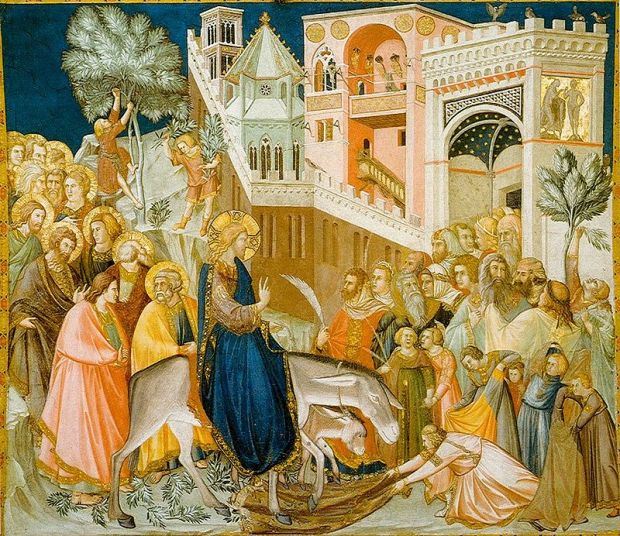
800px-assisi-frescoes-entry-into-jerusalem-pietro_lorenzetti

Entry of Christ into Jerusalem (1320) by Pietro Lorenzetti.

This is a sermon preached on Palm Sunday after a reading of Luke’s account of the “Triumphal Entry”.

I’ve preached here before on Palm Sunday. I know because I always find it a challenge to preach on Palm Sunday and I can remember facing up to that challenge here in a previous year. The challenge is that traditional perceptions of what Palm Sunday should be and my own reading of the scriptures disagree quite fundamentally. Traditionally Palm Sunday is perceived as a time of celebration – a time when the church celebrates with the crowd in Jerusalem before getting down to the real business of Holy Week.

When I read the scriptures that is not what I think is appropriate. If the crowd were celebrating (Luke’s gospel is inconclusive and can be read as suggesting that it was actually the disciples who were celebrating), they were celebrating for the wrong reason. The crowd wanted a political leader to free them from oppression. They wanted a competitor for Pilate who was probably progressing to his palace from the other side of city. For many of them, worn down by years of oppression and poverty, they may simply have wanted a party.

I don’t think, though, that Jesus was celebrating. He chose to ride on a donkey, the most humble of beasts. His is not a triumphant entry, it is a humble entry, even a penitential entry. Jesus knows that in entering Jerusalem he is signing his own death warrant. This is not a time of celebration for Jesus. It is the start of a long walk from freedom to death row. Make no mistake, Palm Sunday is the first day of Holy Week.

The lectionary hides this to a certain extent. It misses the point, it focuses on the celebration. It stops short of the two verses that make it clear that this is very far from a celebration in the eyes of Jesus. ‘He came closer to the city, and when he saw it, he wept over it, saying, “If you only knew today what is needed for peace! But now you cannot see it!”

Jesus weeps for Jerusalem, He sees the celebrating crowds and knows that they are celebrating for the wrong reasons. Put yourself in his shoes, you feel you’ve been sent by God to preach his word. You’ve spent the last three years travelling round the country preaching that word with a disparate groups of disciples and with no place to call home. You thought you were getting somewhere, you thought the people understood. You thought it was time to come to Jerusalem and proclaim God’s Kingdom in the holiest of cities … and when you get there you realise that no-one has understood you – that they’ve got it wrong. How would that make you feel? I suspect it would drive you to weep.

“If you only knew today what is needed for peace! But now you cannot see it!”

Don’t those words resonate for us today as we look around the world? As we watch our televisions, listen to our radios, read our newspapers. We can apply them literally to countries at war or at risk of war. If only we knew today what is needed for peace in Syria. Alternatively we can be more metaphorical and apply them to political turmoil caused by corrupt politicians in countries like Brazil. We can apply them to the fear of immigration that is threatening to dissolve 70 years of peace and cooperation within Europe. We can apply them to the war that we are fighting with our own planet. We can apply them to a war that is being fought within our society and as reflected in the recent turmoil within the conservative party between those who have much and want more and those who have very little. If only we knew today what was needed for peace – but we cannot see it. Palm Sunday is not a time to celebrate with the crowd but a time to empathise with Jesus and weep with him.

But it is more than that – it is also a time of hope. Jesus felt all these things. He must have wondered if all his sacrifices so far had been in vain. He must have wanted to get off that donkeys back, turn around and walk back to a quiet life in the rural town from which he had come. But he didn’t, he continued riding forwards, through the gates and into the city. For all that he must have questioned whether he was being successful or not, he knew that this was his purpose. Recognising how little the people knew of God’s Kingdom he was even more determined than ever to explain it to them. According to Luke’s Gospel he rode straight on to the Temple and began to drive out those who did not understand what the Temple was for, “It is written in the Scriptures that God said, ‘My Temple will be a house of prayer.’ But you have turned it into a hideout for thieves!” Jesus turned his disappointment and pity into motivation to follow God even more actively. Rather than turning away in despair he upped his game in hope.

There are many reasons for the contemporary church to share Jesus’ disappointment, pity and perhaps even despair. As I’ve already noted there are all sorts of situations in our world where what is needed is peace but where society cannot see how to achieve it. After a period of perhaps a thousand years when the church has dominated society within Europe it is in serious decline. Our congregations are getting older, they are getting smaller and in many cases are disappearing. To many of us the society in which we live seems to have turned away from God. Jesus preached of God’s Kingdom for three years only to discover, on his arrival in Jerusalem, that no-one had understood. Has the church in Europe been preaching the same message for a thousand years with the same result?

There is, of course, a complex answer to this question. Whilst there are undoubtedly many aspects of modern society that lead us to despair, considerable progress has been made. We live in a democracy in which all people regardless of gender, wealth, race or physical ability have equal rights. Slavery has been abolished (if not eradicated entirely). Western Europe, at least, has left behind war and recognised that political cooperation is the pathway to future prosperity. For all the tensions within our education, healthcare and welfare systems we recognise that the extent to which we educate our children, care for the ill and support the disadvantaged are measures of the health of our society. Many of these things have been driven by Christians active within society and most of the rest has been driven by a contemporary value system which, whilst becoming apparently more secular, is a direct consequence of that thousand years of Christian teaching.

All this, it can be argued, is a result of Jesus not turning back, of him putting aside his personal sense of despair and focussing on God and the world’s need for His Kingdom, of a recognition that whilst that Kingdom will not appear overnight it will come. It is the result of Jesus placing hope at the centre of his mission.

Let’s do the same. Let’s look at the progress that the world has made through the time of Christendom and give thanks. We should by all means look at the contemporary world and recognise that the completion of God’s kingdom still seems only a far off prospect. But we should recognise that it is a progress that has started, that the Kingdom of God is at hand. Our role as a church, however, small or apparently impotent we may feel ourselves, is to hold up God’s light to the world, to proclaim the Good News, to offer up Hope. In a world that is desperate for peace we must show how this can be attained.  If Jesus, sitting on that donkey, in the middle of a crowd that was celebrating for the wrong reasons, and conscious of the hostile establishment within Jerusalem could continue to hope for the coming of God’s kingdom, then so to can we. Amen.

A new war on terror?

A sermon preached on Sunday 15th November in response to the terrorist attacks on France last Friday. Bible readings were Romans 12:9-21 and Matthew 5:38-48. The readings had been separated by a video of the ABC interview with Diane Foley following the assumed killing of Mohammed Emwahzi, who had killed her son James.

APTOPIX Brazil France Paris Attacks

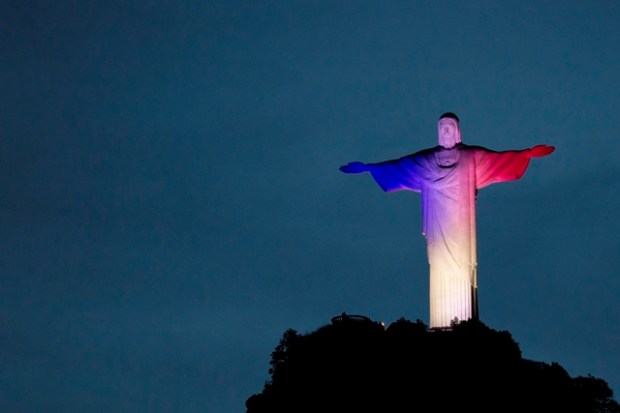
The statue of Christ the Redeemer in Rio floodlit in solidarity with the people of Paris 

Earlier this year in the run up to the election the leaders of all three major political parties launched Easter messages. David Cameron was the only one of them who identifies himself as a Christian. You can see his video on YouTube. The central message is that the United Kingdom is a Christian country and that we should be proud of this and celebrate it. It made me wonder how a Christian country should respond to the outrages in Paris earlier in the weekend.

You might expect a Christian country to look first to the Bible. The Bible, of course, is a complex book, or collection of books. All too often we struggle to find a simple message to guide our actions. I thus often choose quite different passages to shed light on a common topic from different angles. On particular themes however a clear and consistent message is presented and today I’ve chosen two extremely similar passages to emphasize this. The first we’ve heard is from Matthew’s gospel. It is part of the Sermon on the Mount. Few biblical scholars believe that this was ever preached by Jesus as a single sermon. Most think it more likely that this is collation of Jesus’s sayings from throughout his ministry. As such it is generally an excellent starting point to try and explore Jesus teaching.

The second reading is from Paul’s letter to the Romans.  It was written between about 55 and 60BC, about 30 years after Jesus teaching. It was written at a time when Christianity was spreading rapidly through the Mediterranean region. This is, of course, indicated by the title; it is a letter to the Christian community in Rome. In this respect it is quite different to the Sermon on the Mount. If the Sermon on the Mount is a collection of Jesus sayings abstracted from the context in which they were originally delivered then Paul’s letter is to a very specific community at a very specific time. Its contents are practical advice for how to live in the context that the Christians found themselves in. An important part of that context was that the Christians were a persecuted minority who felt powerless to respond to the forces that persecuted them. We read this from verse 14: “Bless those who persecute you, bless and do not curse”.

Mourn with those who mourn

Perhaps the most important starting point in applying these passages to the present situation is verse 15, “mourn with those who mourn”. We are called to empathise with those who have suffered loss. In many ways it is difficult to have any other response given the immediacy of the television news over the last two days. Given those harrowing pictures it is almost impossible not to feel the pain. The pictures go further and reinforce this international mourning process. We started our service this morning with the picture of a woman in lighting candles in the shape of a question mark outside the French embassy in Prague. There have been candlelit vigils throughout the world. The Sydney Opera house has turned into a tricolour as has the Taipei 101 building, the statue of Christ the Redeemer in Rio, the walls of the old city in Jerusalem, the Oriental Pearl tower in Shanghai, the Brandenberg gait. This is a truly modern phenomenon, expressions of global grief unknown before the century within which we now live and sending a powerful message to the French people.

But is our mourning selective? By the latest estimates of the Nobel Prize Winning American group, Physicians for Social Responsibility, 1.3 million civilians have died in Iraq, Afghanistan and Pakistan since the start of the war on terror. This carnage isn’t something of the distant past. It is the day to day reality of life that is being lived out by millions of people throughout the Middle East. Where is the outpouring of grief, where are the symbols of international solidarity for these people. Why do we choose to grieve for some people and not for others? How would the foreign policy of a country that grieved with all victims of terror throughout the world be different from that of a country that only chooses to grieve for the people that it has most in common with? How would a truly Christian country react to the reality of the modern world?

Do not take revenge

The second message that I want to focus on that is common to these two passages is the rejection of revenge as a motive. Paul says this explicitly in verse 19 “Do not take revenge”. Jesus says it implicitly “Love your enemies and pray for those who persecute you”. It is interesting that the section of the Sermon on the Mount that exhorts us to Love our enemy is preceded by the statement over-ruling the old teaching of an “eye for an eye, or a tooth for a tooth”. We have to remember that that was originally a statement of limitation. Where there is no law, disputes readily escalate if the reaction of a crime is out of proportion to the crime itself. There is a strong argument that the American reaction to the events of 9/11 is just such an example. The old demand that the reaction to crime should be in proportion to the nature of the crime helped to stable society. But Jesus and Paul both go further. They both want to remove any motive of revenge from our response. Let God take care of revenge, let us explore how to respond in love.

The reactions to the killing of Mohammed Emwazi amongst the relatives of the people he killed have varied greatly. Many have expressed relief, a few have expressed satisfaction, but, as a Christian, the one which spoke most deeply to me was the response we have heard this morning from Diane Foley. The emotion she expresses is one of sadness. Sadness that yet another individual has been destroyed by conflict. Sadness that something awful has transformed an ordinary young , who was remembered this week by his previous teachers as hard working and proud of his educational success, into a pathological killer. Her son, she says, would have wanted to befriend him. I don’t know what religious background Dian Foley comes from, I don’t know what motivated her son, but I do know that his actions and her words embody in the twenty-first century what both Jesus and Paul were talking and writing about  2,000 years ago.

Yet both David Cameron and Francoise Hollande, following in the pattern set by George W Bush after 9/11, have promised revenge. Both have promised to pursue the perpetrators “without mercy”. Is this the response of a Christian country? Micah reminds us that what God requires is that we, “Act justly, love mercy, and walk humbly with our God”.

Overcome evil with good

The response of a Christian country, I believe, is encapsulated in the last two verses of the reading we have heard from Romans:

“If your enemy is hungry, feed him; if he is thirsty, give him something to drink … Do not be overcome by evil, but overcome evil with good.”

In our response to this weekend’s events let us not try and respond to terror with ever more terror, let us not demand a tooth for a tooth or an eye for an eye. Let us seek to overcome evil with good.

The American war on Iraq has been calculated to have cost America 1.1 trillion dollars. That is just the American contribution and is limited to Iraq. According to the Ministry of Defence the UK contributed a further £8 billion. We spent even more money on the war with Afghanistan (although the Americans spent less). To put this in context, the Americans spent more on the war in Iraq than they would spend on their total budget for overseas aid for the whole world for 35 years.

Just imagine if instead of waging a war with weapons that the Americans had listened to Paul and had chosen to wage a war of love. Just imagine if instead of funding all those bombs that they had chosen to offer the same money to  build schools. Instead of sending troops to kill and control they had sent doctors and nurses to care and to heal. If they had beaten their swords into ploughshares and their spears into pruning hooks.  If they had seen that their enemy was hungry and fed him, if they had recognised that their enemy was thirsty and given her water.

I know that this appears totally unrealistic, that it is an aspirational vision that can never be achieved. It’s not at all clear how America could have acted like this while Saddam Hussein was still in power. But isn’t that what our faith is about? Isn’t our faith about taking a vision of the Kingdom of Heaven and offering it to  the world? Isn’t it about looking at the world and saying, “yes this is how things are, but let’s imagine how they could be”? Isn’t it above all about praying, “thy Kingdom come, thy will be done, on earth as it is in Heaven.”

Tax credits and development goals

A sermon preached on 25th October 2015 based on the readings from Deuteronomy (15:1-11) and Luke (6:20-26).

I’ve felt called to move away from the lectionary readings this week and instead talk about Christian attitudes to wealth and poverty. This is a response to the news that we’ve been reading about in our newspaper’s, listening to on our radios or watching on our televisions.

I don’t think anyone can have escaped the public debate over the last couple of weeks about the cuts that the government is proposing to tax credits. Taking figures from yesterday’s Daily Telegraph 3 million families are going to lose an average of £1,300 of their income. This is one in every six families. These are not a randomly distributed 3 million families these are 3 million of the poorest working families in the country.

Many of us will have watched as Michelle Dorrell, the mother of one of those families, talked of the affect that this would have on her family on Question Time last week. Others will have heard the maiden speech this week of Heidi Allen, Conservative MP for South Cambridgeshire, calling on the government in general and the chancellor in particular to change his mind. She reminded him that whilst this might appear to him to be an abstract decision to balance the books that to many of her constituents it was a very concrete threat to take away a considerable part of their income.

Less than a month ago our Prime Minister, David Cameron, was in New York addressing the General Assembly  of the United Nations at the launch of their new Sustainable Development Goals. The first of these is to “end poverty in all forms everywhere”. The first sub-clause of this is devoted to ending extreme poverty defined as individuals living on less than $1.25 a day (about 80p). We should be thankful  that there are very few people  in the UK living on those incomes that low. The second sub-clause is to “reduce by half the number of men, women and children who are living in poverty in all its dimensions according to national definitions”. This is going to be difficult to assess for children in the UK because in July the government announced that it was no longer going to capture data on relative child poverty in the UK. Without that we won’t know whether child poverty is increasing or decreasing. Perhaps we  can now see some method in the government’s apparent madness as the withdrawal of tax credits is almost certain to increase substantially the number of children living in relative poverty in this country.

The third sub-clause of the end poverty goal that out Prime Minister signed up to was a commitment to ”implement nationally appropriate social protection systems and measures for all”. At the moment tax credits are one of the UK’s primary social protection systems and the government are significantly reducing these. Poverty and how to address it is well and truly on the national agenda this week.

Most of the world leaders were extremely positive and welcoming of the sustainable development goals. The Pope was a little more reserved saying, “We must avoid every temptation to fall into a declarationist nominalism which would assuage our consciences.” It’s a bit wordy but what he was pointing out was that these are only goals. There is no concrete plan as to how to achieve them. Particularly in relationship to the poverty goals there is an implicit assumption that these will be achieved simply by allowing economic development to continue the way it has for the last fifty years or so. If we simply allow the world economy to continue to grow then some of those benefits will trickle down to the poor. Essentially the UN appears to be saying that if we do nothing then extreme poverty will disappear as a consequence of the trickle-down effect. As the rich get richer and the very rich get stupendously rich, then the poor will get a little less poor.

Other critics have gone further, examining the language used by the UN. They claim that this language treats extreme poverty as a disease. The first sub-goal is to eradicate poverty very much in the way that we have eradicated small-pox and are close to eradicating polio. It assumes that poverty is something like a virus, a malignant germ for which we are not responsible, but which we must fight against. Nothing could be further from the truth they say. Modern day poverty is largely a consequence of how man-made economic structures operate. Modern poverty is not a consequence of our failure to generate wealth, as assumed by the development goals, it is a failure of our capacity to fairly distribute wealth. Poverty, they argue, will never be eradicated by allowing capitalism and the God of the free market to flourish unrestrained because this is precisely what has caused the problem in the first place.

So what does the Bible say? This is quite an easy question to answer because so much of the Bible, including, large parts of Jesus’ teaching, is about attitudes to poverty and wealth. The picture that emerges is remarkably consistent throughout the Old and New Testaments. It is reflected in both our readings this morning. It’s  radically different form the Sustainable Development Goals because throughout the Bible concern for the poor is balanced by condemnation of the rich. The rich are portrayed as part of the problem.

Luke’s version of the beatitudes, which we have heard this morning, is read much less often than Matthew’s perhaps because it is much less comforting. While both heap blessings on the poor, Luke includes condemnation of the rich:

But woe to you who are rich,
for you have already received your comfort.
Woe to you who are well fed now,
for you will go hungry.

For those of us who are rich, and from an international perspective, this includes all of us sitting here this morning, this is extremely challenging. It clearly identifies us as part of the problem.

But this is not an isolated text. Jesus words on this occasion reflect a substantial theme of Biblical writings tracing right back to some of the earliest texts ever written down. The acknowledgment that the rich and powerful are responsible for many of the ills of society can be traced to passages in Deuteronomy, Job, Jeremiah, Isaiah, the Psalms and Proverbs, Amos, Hosea and Micah.

In many places the Bible goes further and either demands or foretells a radical redistribution of wealth from the rich to the poor. Our reading from Deuteronomy this morning is of the law regarding the year of Sabbath. The basic principal was that at the end of each seven year cycle all debts were cancelled. Debt are generally owed by the poor to the rich so this is effectively a redistribution of wealth. This was done explicitly to ensure that there “will be no poor among you”. At the end of seven such cycles was a year of Jubilee when all wealth and land were distributed back to its original owners. The books where re-set and everyone was given a second chance. This redistributive mechanism is at the heart of the Judaeo-Christian tradition and was put there to ensure that the poor in society should never be allowed to get too poor and that the rich should never be allowed to get too rich.

The Sustainable Development Goals look through the wrong end of a telescope and see the poor as the problem and aim for their eradication. The Jews perhaps 2,500 years ago were far more advanced in their thinking in seeing that it is not the poor who are the problem, it is the rich. As one commentator said in the aftermath of the UN conference, we will never eradicate extreme poverty if we do not also set out to eradicate extreme wealth.

Even if eventually a trickle-down effect operating within current financial systems does eventually remove absolute poverty it is driving an even more unequal distribution of wealth within society. This is essentially the substance of Thomas Picketty’s recent book, Capitalism in the twenty-first century and is confirmed by almost all contemporary analyses of wealth distribution at national and international levels. The fundamental requirement for tax credits arises because incomes amongst the lowest paid in our economy have fallen so low over recent years that they are impossible for a family to survive on. This has occurred at the same time as the income of the highest paid in our economy have continued to escalate.

If anything our current tax system is reinforcing this inequality rather than resolving it. Figures released in July, and reported in the Independent, showed that the top 20% of households actually pay a smaller percentage of their income in tax of all forms than the lowest 20%. The planned reductions in tax credits will make this even more extreme.

Even if extreme absolute poverty is eventually eradicated we will have even more extreme relative poverty. The poor, as our Old Testament reading reminds us, are not a disease that can be eradicated, they will always be with us. The challenge for Christians is not how to eradicate the poor but how to welcome and accommodate them within society. It is not about how to generate ever more wealth, at the expense of the natural resources of a finite planet, but about how to distribute what we’ve got. It is about adopting a concern for the poor as a driver of our economic systems and acknowledging that this will require a redistribution of wealth from the rich. Above all it is about making Jesus own prophecy central to our economic goals:

“Blessed are you who are poor,
for yours is the kingdom of God.
Blessed are you who hunger now,
for you will be satisfied.
Blessed are you who weep now,
for you will laugh.”

Relating to other faiths

This is a sermon preached on 26th October based on the readings Revelation 21:22-22:5 and Luke 6:27-42.

I want to talk about our relationship to other faiths this morning. What I have to say will be generalisable but will focus on our relationship with Muslims. Clearly there is much fear in our world about Muslim fundamentalism. This is the first opportunity I’ve had to preach since the beheading of Alan Hennings. He was the Salford cabbie who went to Syria  to try and help. Although I’ve never met her his wife, Barbara, works in my department at the University where there has been  a particularly strong and emotional reaction to the news.

We heard yesterday of the death of Muhammad Mehdi Hassa, the fourth of six young men from Portsmouth who went to fight for Islamic state. Somehow, we don’t know how, they and an estimated other 500 British Muslims have been convinced that this is what their faith requires of them. Most of us are horrified and bewildered. An all too easy response, particularly I think amongst Christians,  is to assume that this is  further proof of  the error of Islam. It’s this that I want to explore this morning.

The first and most obvious point I want to make is that there are a wide spectrum of beliefs within Islam just as there are within Christianity. My daughter has just finished her GCSE and is now taking A-level religious studies. At GCSE it was considered appropriate to write about “what Christians believe” or “what Muslims believe”. At the new level she is working at she has been told that this is no longer appropriate. She needs to write about “what some Christians believe” or maybe about “the official view of the Methodist church” or to mention the views of a specific individual who has a particular faith. Just because we are appalled by the actions of some Muslims does not mean we should condemn all Muslims or the faith of Islam.

We lived in Northern Ireland for several years just after the first IRA ceasefire was announced. During that time we lived within a Christian community that was appalled about the deeds that had been done by people who considered themselves Christians and truly believed that they were doing what God wanted. We as Christians wanted nothing to do with the acts of Catholics working within the IRA or of protestants within the Unionist paramilitaries. Most of us within this church this morning would be appalled to hear those acts portrayed as the acts of Christianity. Why then, do we fall into the trap of assuming that the isolated acts of small groups of Muslims involved in terror activities are representative of Islam?

We also need to develop some historical perspective. The trauma that some parts of Islam are experiencing now is extremely similar to trauma that some parts of Christianity passed through several centuries ago. 16th and 17th century Europe was riven by religious conflicts between Catholics and Protestants every bit as brutal and uncompromising as the current rivalry between Sunni and Shia Muslims in the Middle East today. On St Bartholomw’s day in 1572 between 5,000 and 30,000 innocent French protestants were murdered by Catholic mobs in Paris and across France. (The only hard evidence for numbers is a bill for workers in Paris to remove 1,100 bodies from the Seine and bury them).

This is just, of course, one particularly horrendous example but history is littered with others of how feuds within Christianity have led to tyranny and death in different communities across the world. (The secular world does not escape either of course. There can be no stronger example of the senseless beheading of innocent victims than the French revolution, perhaps the first time a secular state emerged within the Western world).

In our reading this morning we’ve been reminded of Jesus’ words that we “should take the plank out of our eye” before “taking the speck out of our brothers”. In looking at the state of parts of current Islam we need to recognise that this is where we, as Christians, have already been. Our first response should be one of recognition. Our second response, perhaps, should be more positive, in recognising that  this is a place that we have come from (albeit more recently than many of us would care to acknowledge). Perhaps there is help we can offer their community from the previous experiences of ours.

Of  course this assumes we would want to. Why should we offer support to a different religious community, one who some would see as  in competition with our own – a community that some within Christianity would see simply as wrong and misguided? Shouldn’t we be fighting against that community as part of our responsibilities as Christians?

Whilst there are certainly writings within the New Testament that can be used to support such attitudes I don’t think that those we’ve heard read this morning do. The injunction of Jesus for us to love our enemies is perhaps one of the most preached about and least implemented in the Bible. What credit do we get for loving people who are just like us? What God wants is for us to love people who are different to us. How, in the modern world can we best love Muslims? That is the question we should really be asking. Of course the paradox within this is you cannot love your enemies – if you love your enemies they become your friends.

There is disagreement here within Christianity (its actually a good example of the variety of opinion within Christianity that I outlined above). Some Christians are extremely confident in their particular brand of Christianity. They believe that through the Bible and Jesus that we know the truth and that everyone else is wrong (there are plenty of passages of scripture that can be cited to reinforce this view). For this group of people the most loving thing we can do for Muslims is to show them how wrong they are and convert them to our way  of seeing and doing.

My faith, and the faith of many other Christians, is different. I don’t have the same faith that the Bible represents the Truth in this way. Within the Bible are so many contradictions that you can’t say that it convey a simple truth. One of the Ten Commandments is that “Thou shalt not kill”. The teaching of Jesus would appear to reinforce this message. But then in Joshua we read of how God stopped the sun in the sky so that the Jews could complete their slaughter of their enemies. That’s just an example of a contradiction within the Bible. I’ve already given examples this morning of what happens when on top of this we layer the competing claims of different denominations and different interpretations of our scripture. It is ludicrous, in my eyes, to see Christianity as a single embodiment of the Truth that is either possible or desirable for us to inflict upon other people.

My faith sees all of us, all people throughout the world, as trying to make sense of life. For me it is important to start in humility with an assumption that we know very little. This is, to me, what Paul meant when he talked of our “childish ways” and how now we see “as through a glass darkly”. Christianity offers a framework through which we can explore what meaning life might have rather than a rigid prescription of what that meaning is. Before it was called the church the early Christian movement was known as “the Way”. It was a way of being in community, a way of exploring faith, a way of drawing closer to God. A God that was defined by people’s experience rather than by what had previously been written in the scriptures. For me the New Testament has a unique place in guiding my spiritual development but it is not the only place.

The images of the End within the Bible are incredibly important. I, with many other Christians,  believe they are poetic and metaphorically images of what we should aspire to rather than literal accounts of what will happen but they are no less important for that. (Indeed as science gives us clearer and clearer predictions of what how the physical universe is likely to end  I’d argue that a metaphorical understad=nding becomes more important.) The image we’ve had presented to us from towards the end of Revelation has very little to do with what we see as Christianity today. The reading says very explicitly that there is no Temple. In a sense religion has been brought to an end. When all people see the Truth there is no longer a need for a Way to guide them towards it. There is an undefiled city where all people can dwell, there is a river filled with the crystal clear water of life. There are trees that bear sufficient food to feed us all and whose leaves are for the healing of the nations.

This vision is of something bigger than the Christianity we practice today. It has no denominations, it has no church councils or preaching plans of flower distribution rotas. It is something different. It is somewhere I hope I am traveling towards  but it is also somewhere that I know I am a long way from. I look to Christianity as a guide  on that journey.  But this guidance will be needed less and less the closer I get to arriving, the closer I get to seeing face to face.

If I see myself as an individual who knows little and is travelling on a journey then I have no real difficulty in seeing members of other faiths as people who know little and but are traveling on a journey also. The journey is along a different path with a different guide but may still be towards the same destination. I have no doubt that the scriptures I revere and the faith experiences that I have had can support others on that journey. I will not stop preaching the gospel in which I believe. But I will offer that to a fellow traveller acknowledging that they may still want to walk along a different path.

Perhaps most importantly though I want to listen. If what I know and what I have experienced can help others then maybe what others know and have experienced can help me. If we are all one day going to share the same city, the same river and the fruit of the same trees, maybe we should start sharing more of our lives now.

One of the most special evenings of my time in Melbourne was in the home of a Muslim family. One of the responses of the Australian Muslim community’s responses to 9:11 was to issue an invitation through the local churches for people to join an Iftar feast within a local home. The Iftar feast is that which starts at dusk on each night of Ramadan when Muslims who have been fasting throughout the day can eat again. A group of us turned up on at a suburban house in the north of the city and were welcomed by a young woman wearing a head scarf. She and her husband sat us down and told us of their faith and gave us an opportunity for us to tell them of ours. As the sun set we turned on the television to hear the Muezzin’s call to prayer. They left briefly to say their prayers and then returned to serve food over which we continued to talk. Despite many experiences within Australian churches this was probably the most spiritually moving encounter I had in the nine years we were there. Driving home I felt truly blessed.

When people talk to me of Muslims the image that comes to my mind is not of a bearded terrorist. It is of a young Australian woman in a head scarf  whose house I entered into in a state of unknowing and left in a state of grace. For her role in helping me on my journey, I give thanks to God – whatever we may both choose to call him.

I’d selected the hymn, God is love let heaven adore, after I’d selected the theme but before I’d decided what to say. As we sang it in church just before I preached I was struck by just how closely its theme’s mapped on to mine.

Maggoty world? A harvest sermon

This is sermon I preached at our harvest festival this year base on two readings: Exodus 16:1-8, 13-20, 31-32 and Luke: 12:22-34

I want to start my sermon this morning by asking why, in the modern, world we celebrate harvest in the way we do?

Modern food production doesn’t require a great deal of ploughing the fields. Most of it is now based on forcing hydroponic crops hidden within poly-tunnels. There’s little scattering of seed either, its all drilled in exactly the correct amounts to produce the yield that the farmer thinks the land can sustain. Food supply is now a multi-million pound industry. There are multi-million dollar investments and corresponding profits for the processors, distributors and retailers (but often very little for the original producers). There is little seasonal variation, just modest fluctuation in prices. The only changes we see are at the checkouts where we now know that toffee apples indicate the lead up to Halloween, mince pies the long lead up to Christmas and  chocolate eggs the even  longer lead in to Easter.

For most of us living in this town and worshipping in this church, food is constantly available and (despite having risen in price recently) reasonable affordable. At one level if we look back to the reading from Luke and Jesus’ teaching that we shouldn’t worry about where our food is going to come from then we are already there. In  a very real sense we don’t worry about where are food is going to come from (even if we sometimes grumble a bit about how much it costs.

Jesus was talking, however, to a very different audience when he told them not to worry about what they are going to eat. In New Testament time and for the poor rural community that  he was talking to things were very different. Most of the people in that audience would have had very real concerns about where food was going to come from. Many small-holders would have been reliant on storing the produce from one harvest well and hoping that it would last through to the next. For the poor there would have been little margin for error, little money to buy food if they got it wrong. Even immediately after the harvest there would have been a concern not too eat too much in order to make it last. There would have been a constant tension over food and its availability. Can you imagine living like that?

Of course there are a growing number of people in today’s society who can tell you exactly what that feels like. At a time when the rich are being given tax breaks to try and stimulate the economy many of the poorest people in our society are finding their benefits cut  and councils are having to reduce services. The Christian Fellowship up the road have felt a need to set up a food bank  and, rather depressingly, it is doing swift business. Even in a relative prosperous area like ours people need its services. All the food we’ve brought forward this morning is going to a similar food bank in Salford. I travel from here to Salford for work every day. I can see the very different economic environments. If we need a food bank here just imagine how much more this food is needed in Salford.

If you think about it Jesus’ contention that we should “not worry about the food we need to stay alive” has two sides to it for those of us who don’t worry about where our food is coming from. One is that we, who have food we need, should worry less about the food we want. In the Lord’s Prayer we pray only for bread, we don’t pray for caviare or champagne or even microwave tagliatelle. The other side is that we who have food, need to make certain that those who don’t, don’t have to worry either. In the good News Bible today’s reading is divided into two parts the first is headed “Trust in God” and is about Jesus telling us not too worry. The second is headed “Riches in heaven” where we are told to give our wealth to the poor. This is wrong, the passage as we heard it this morning is a coherent whole becasue the poor will never be free from their worries about food while the rich refuse to share.

I started off by asking why, in the modern world without seasons, a world with a constant food supply,we need to celebrate harvest.  May be the answer is that  there is a need once a year at least to remember the people who have a very difference experience – who are worrying from day to day about how they will feed themselves. This of course, is what we already do, all the gifts of food that people have brought this morning will be being shared with people who are considerably less well off than ourselves. In a small but prophetic way we are living out Jesus’ teaching.

Maybe harvest in the modern world is a time not just for giving thanks but for expressing anger. If the UK is the sixth largest economy in the world why is it that so many people struggle to put food on the table? If we can afford tax breaks for the rich why can we not afford food for the poor? What is wrong with the society in which we live? I think one of the problems lies in our democracy. For a long time through the late 19th and most of the 20th century the majority of people in the UK could be classed as poor. Democracy tends to favour the majority and over that period there was a general improvement in the condition of the poor and many families were able to work themselves out of poverty. I think we’ve reached a position now that the majority of people in the UK can be classed as well-off (maybe not rich, but well-off). There is a very real danger now that in pursuing the votes of the majority, our political parties will forget the needs of the poor. We as a church are one of the few organisations that still have a concern for the poor and, at the modern harvest, that is one of the messages we need to scream from our pulpits.

But there’s another reason why I think harvest is so important for the modern world. The story that I think best illustrates it is that story of the Jews wandering in the wilderness for forty  years. Early on in their journey they were starting to feel what it is to live without food, they thought they were going to die. Moses took their plight to God and God provided for them. Each morning he sent a substance like bread to coat the ground and instructed the Israelites to pick up just as much as they needed for that day. But who was listening closely? What happened if people gathered more than they needed for the day and tried to hoard it? Yes, it went maggoty and started to smell. I want you to hold that image in your head. Maggoty bread that has started to smell. We don’t need to believe in the literal truth of the story to be captured by the power of this image. Maggoty bread that has started to smell.

Is this not what always happens when we try to take too much? Look at the environment within which we live. Look how we have taken more than we need from it over the last two hundred years and see how it has responded. Think of it as a world that has gone maggoty and has started to smell. Remember the earlier part of my sermon. Think of how within Britain the well off have taken more than we need. Think of this as a world that has gone maggoty and started to smell. Think further afield, perhaps to the people of Burund that the Methodist Relief and Development fund would like us to remember this Harvest. Remember how the people of Africa have been exploited by the developed worlds desire to take more than it needs. Think of this as a world that has gone maggoty and started to smell.

The Biblical message is clear – if we only take what we need then we will live. If we take more  then we will die. It’s interesting to contrast this with the message of all the political parties at the moment (indeed that of mainstream economics throughout the developed world). They say that we need our economy to grow in order for us to move out or recession. But think about that. What is “growth”? Growth is wanting more. Growth is not being happy with what we have. Growth is the very antithesis of what God asked of the Jews in the wilderness or of what Jesus asked of his followers in Galilee. Where God and Jesus asked us to be content with what we have, western governments and asking us to be greedy for more. This cannot work. Continued growth on a finite planet is just not possible. The faster we grow the sooner we use up the resources. Growth of the rich in a divided world will only lead to a more divided world. The last thing the developed world’s economy needs is growth. Very few people in positions of power recognise this, very few people voting for them in western democracies understand this.

Solutions aren’t easy. Working out how the World’s economy might work if not driven by growth means challenging the whole basis of consumer capitalism. But solution’s don’t come unless someone, somewhere, first recognises the problem. Maybe this is a role for the modern harvest festival. To give thanks for what we have first but then to go further and to proclaim that it is sufficient. We do not need any more. Heaven will be made real on earth when we acknowledge the sufficiency of what we have. It will certainly never arrive if we continually strive for the things we haven’t got and don’t need. It’s a message not just for the Church but for the whole world everywhere and, along with our concern for the poor, it is a message that we should be preaching from every pulpit this harvest.