
wealth

Rich foolishness

 A sermon for harvest 2024 based on Luke 12:16-21

“The land of a rich man produced abundantly. And he thought to himself, ‘What should I do, for I have no place to store my crops?’ Then he said, ‘I will do this: I will pull down my barns and build larger ones, and there I will store all my grain and my goods. And I will say to my soul, Soul, you have ample goods laid up for many years; relax, eat, drink, be merry.’ But God said to him, ‘You fool! This very night your life is being demanded of you. And the things you have prepared, whose will they be?’ So it is with those who store up treasures for themselves but are not rich toward God.”

The gospels are written in unbelievably condensed language. This morning’s reading, the Parable of the Rich Fool is told in 125 words. I would guess that if any of us were asked to retell the story as concisely as possible we would use many more.

It is impossible to believe that this is how Jesus actually spoke in public. People who make a considerable effort to hear a public speaker don’t typically want a sequence of super-condensed sound bites. They want to be captivated, inspired and entertained by something more substantial. The gospel writers have captured the essence of the parables as concisely as possible, but if we want to relive the experience of Jesus’ preaching and teaching we have to imagine the bits that the gospel writers leave out.

We also need to remember that the people that Jesus was talking to two thousand years ago when he first told the story lived very different lives to those we live today. They would have recognised things in the stories he was telling that we risk missing. Most of Jesus’ teaching was in Galilee, a largely rural province with poor links to Jerusalem the more cosmopolitan city in the south. The country was poor with many people with little education and dependent on subsistence farming or fishing. They would have recognised and related to quite different things in the stories to those we recognise and relate to today.

The story, for example, is that of a rich man. In our world we tend to idolise the rich. We often assume that with their wealth comes knowledge and wisdom. We might assume that a rich man will be the hero of a story. Poor people, particularly tenant farmers, will often have a different perspective. Throughout history the rich, or at least those who have not inherited their wealth, have often accumulated their wealth through exploitation of the poor. Think of how many of the super-successful businesses of today award great salaries and bonuses to their owners and top-level management but refuse to pay their front-line staff any more than the minimum wage. In unregulated subsistence economies like that of first century Galilee the poor people listening to Jesus would almost certainly have responded to the introduction of the character as a “rich man” with suspicion and contempt. It’s not beyond imagination that they might have responded with pantomime boos and jeers.

There has been a good harvest, presumably because of factors entirely beyond the control of the rich man – rain at the right time to germinate the seeds and sun at the right time to ripen the grain. The crowd would know that a good harvest was a gift from God and had little to do with the merits of the landowner. They would also know that the man had had little involvement in gathering the harvest other than to order his stewards to recruit casual labour from the gig economy at rock bottom wages. The crowd might even understand that the man only owned the land because he had inherited it form his father, and he from his father before that, right back to the time when some ancestral warlord had stolen the land from those who had originally inhabited it.  Despite all this the man has no reservation in asking, “What should I do to for I have no place to store my crops?” with a very clear emphasis on “my”. More boos and jeers from the crowd?

And what of his decision to build bigger barns? Why not just sell the excess grain. The audience knew the answer, there’s a business opportunity isn’t there. If the man has experienced a bumper harvest, then the chances are that other landowners have as well. Grain will be plentiful, and the price will have dropped. Building bigger barns is a mechanism for hoarding the harvest until a future time when grain becomes scarce and the price rises accordingly. The crowd listening know that the building of bigger barns is a mechanism for extorting higher prices for grain from them sometime in the future. They see investment of current wealth as a mechanism for exploiting them to generate yet more wealth in the future. Even more boos and jeers.

The rich man is satisfied and looks forward to the security of consolidated wealth. Imagine what that feels like to subsistence farmers and hired labourers who never know where their next mouthful of food is coming from. There can have been little sympathy for the wealthy man. It there were any wealthy people in the crowd you can imagine them getting a little nervous and sweaty as Jesus progresses with the story. You can imagine why, ultimately and corporately, they decided that Jesus was a dangerous influence who needed to be done away with.

But for the moment Jesus is speaking the language of the crowd and has got them in the palm of his hand. Then the punchline. God takes the life of the rich man. All that wealth squirrelled away, all that prospect of future comfort, all have come to nothing. Did the boos and jeers of the crowd turn to cheers and laughter. Yes, the rich man has got his just desserts.

One problem with this parable is that it is almost entirely negative – it is clearly very critical of how the man did behave but tells us very little about how he should have behaved.  At the heart of the story is the question that the rich man asks himself, “What should I do for I have no place to store my crops”, what should he have done?

This is an example of Jesus genius in responding to a question by telling a story which makes the answer obvious to the audience without needing to give it. He did it with the Parable of the Good Samaritan and his response to the woman caught in adultery. Here he tells a story which makes clear the Christian response to wealth generation without having to state it explicitly. The Christian response to wealth generation is to give thanks for good fortune and to seek to share that good fortune with others.

One thing that puzzles me about the modern church is why we are not more critical of hoarded wealth, why we don’t tell equivalent stories. You can imagine the trouble that the we would get into if it started filling out this story in the way that I’ve imagined Jesus filling it out. We’d be told to keep our thoughts away from politics and to get back to praying silently on our knees where we belong. Perhaps one issue is that, in a complex world, the injustices of how society is structured are much more difficult to discern than in the earlier, simpler world in which Jesus taught. Or maybe it is because those with wealth are controlling how we perceive the world.

We are currently fed a story that our economy is failing, that as a nation we have no money to spare and that we need to cut back on provision of services to the disadvantaged and vulnerable because we have no way of funding them. We are taught that the only way that we can find such resources is by growing the economy. This is simply not true. We are the sixth wealthiest nation in the world in terms of our gross domestic product. According to the Organisation for Economic Cooperation and Development GDP is “the standard measure of the value added created through the production of goods and services in a country”. Accountants and economists might argue about the details, but you can think of this of the money that we earn as a country each year. If you divide this by the number of people in the country you obtain an estimate of how much income every person would receive if that money was shared equally among the population. According to the International Monetary Fund this is projected to be just under £40,000 per person (US$51,000) for 2024. This is the whole population, so every family of two adults and two children could receive £160,000 each year. The key issue here is that this would be the case if the country’s annual income were shared equally among the population – it isn’t.

How would the national dialogue on how we manage the country’s resources and share its wealth be different if we told the truth with the same clarity that Jesus told the truth? How would it change, if gloomy predictions of how slowly the economy is growing where replaced with celebratory statements of how much wealth we already generate. Harvest is a time to give thanks for what we have received and to then think about how we share it. This harvest, let all Christians in the UK strip away the gloom of how slowly the nation’s income is growing and give thanks for the abundant wealth which we already receive. But let’s go further than giving thanks, let’s take the next step and ask how that wealth should be shared.
Living for God’s kingdom at a time when it seems to be getting further away

A sermon following the lectionary readings, the first half of Psalm 22 (see here for a powerful Australian paraphrase) and the story of the rich young ruler as told in Mark’s gospel

Introduction

I’ve found this a rather difficult week. I have very real reservations about how many things in society are heading at the moment. The rational scientist in me looks at how things are going and concludes a bleak future awaits us all. The feeling Christian in me grieves for all those who will be caught up in this process and the struggles they will have to endure. When I read today’s Psalm, which starts off as a lamentation, it struck me as a powerful, poetic description of what it is I feel. The only difference perhaps being that the psalm is written as a personal lamentation whereas the grief I feel is for our community.

Monday saw the publication of the latest report from the intergovernmental panel on climate change. The report makes salutary reading. Scientists opinions on this subject are always estimates and their analysis of the growing evidence is that these estimates have been too generous in the past. The effects are being seen earlier and more severely than they had expected. They are now saying that we need to take even greater actions even earlier than their previous recommendations. Of course this report comes at a time when world governments are failing to meet even the looser earlier requirements.

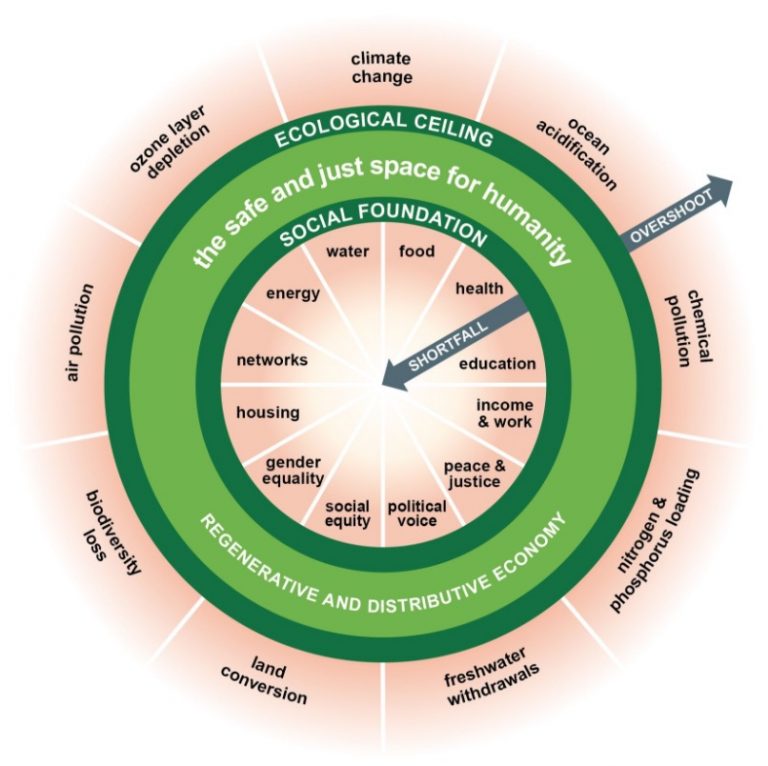
But it’s not just climate change. There are a number of other large-scale environmental factors including loss of habit and biodiversity, acidification of the oceans, degradation of soil, pollution of the atmosphere and oceans, and increasing shortages of fresh water (these are summarised well, and not too bleakly, in Kate Raworth’s book, Donut Economics). On all these fronts the future looks bleak if we progress as we now are.

screen-shot-2017-04-05-at-08-26-50-768x766

Then there are economic factors. There is growing inequality in wealth distribution with the rich flourishing and the poor being left to fend for themselves. Economic growth is largely funded by personal and governmental debt which is clearly unsustainable. Within our own country the health, education, law enforcement and social care provision is being starved of funding and is failing to support the most basic needs of many of our population. We see this particularly in the growing debate, in the second half of the week about the consequences of continuing to roll out universal credit in it current form.

And all of this is contributing to a growing crisis in our mental health services. Wednesday was UN World Mental Health Day. It is essential that such days are used to remind ourselves on the scale of this problem but it led to another slice of confronting publicity. We were reminded that mental health problems, and particularly those amongst the young are getting worse. At any given week one in six people experiences as common mental health condition and the funding of mental health services is simply nowhere near what is required to satisfy this need.

The stereotype of the old street preached is based around the message, “Repent all ye sinners for the end of the world is nigh”. The modern equivalent is perhaps not a pronouncement that this world is going to end but that is going to change beyond our imagination in the decades to come and that most of that change is going to be in a direction that we would rather not imagine. I don’t think its healthy to dwell on this all the time but every so often I think it is important that we acknowledge what is going on in our world and how we feel about it.

Reading the story of the Rich Young Ruler as a critique of contemporary society

At first sight the gospel reading doesn’t seem to align with either the psalm, or the reading from the book of Job which is set as an alternative, or the introduction I gave to this service earlier. The story is almost always taken as referring to a particular individual, the rich young ruler. Indeed some commentators have suggested that Jesus teaching should not necessarily be extended to anyone else. This man had a specific problem, they say, and Jesus offered a specific solution. If don’t have that problem then the teaching needn’t apply to us.

It might not surprise you to hear that I don’t buy into this and I’m actually going to take a different slant on this story. I’m going to suggest that this story and Jesus’ subsequent teaching can be taken at a societal level. Indeed when the man has departed disappointed and turns to his disciples Jesus doesn’t lament for an individual, he expresses a generalisation, “How hard will it be for rich people to enter the Kingdom of God”.

Note the difference here between what the man asks for and how Jesus talks afterwards. The man asks what he need do to “inherit eternal life”. Jesus reflects on what is required to enter the “Kingdom of God”. This is characteristic of the synoptic gospels, Matthew, Mark and Luke, which contain probably the best record we have of what Jesus actually said.  “Eternal life” is obviously tied up with ideas with what will happen somewhere else after we die and is rarely on Jesus’ agenda. He is much more interested in proclaiming the “Kingdom of God”, a vision of how the world is and will be, “on Earth, as it is in Heaven”.

Jesus’ linkage of the coming of the Kingdom to our attitudes to wealth is important in our modern context because almost all of the environmental problems that our world currently faces are a consequence of our focus on accumulating wealth, of wanting more stuff for ourselves and our children and our grandchildren. Whilst our lives are immensely enriched by that stuff, it is the factories and agricultural processes that we use to produce it that are causing the problem. Our industries pump out vast amounts of carbon dioxide and other pollutants into the atmosphere and our farming expands to satisfy our needs leading to environmental degradation, habitat loss and eventually extinction of many species which used to live where we now grow food. The problem isn’t limited to our material wealth. Our wealth is now expressed as much through the experiences we crave for as well as it is through the stuff we accumulate. Travel for tourism is a particularly damaging for the planet through the carbon dioxide emissions from air travel, degradation of once vulnerable and once inaccessible ecosystems, and distortion of local economies to serve the needs of tourists rather than local inhabitants.

Many of our economic and social problems are also, essentially, a consequence of our societal pursuit of wealth. The drive for wealth creation, gross domestic product, under current economic models is leading to suppression of wages for those on low incomes to fund large pay outs for investors and exorbitant salaries for those at the top of industry who maintain this system. The desire for houses and furnishings and cars and holidays keeps us enslaved to our jobs and exacerbate worries about income and job security which are two of the largest drivers of mental health problems.

In short, our society’s obsession with wealth accumulation and economic growth is one of the largest barriers to the coming of God’s Kingdom in our modern world. Jesus clearly didn’t respond to this Biblical incident with a critique of the twenty first century market economy, but he did recognise, in the earlier and more localised economy of which he was a part, exactly the same factors operating as wreak havoc in our world today. There is no doubt in my mind that there are important societal messages in the words we have heard read this afternoon as well as the requirement for a personal response that preachers normally focus on when preaching from this text.

Re-focussing on and celebrating Kingdom priorities

Changing societal attitudes to wealth and wealth creation is a huge political challenge. Where do we start?

Perhaps the first thing is to realise that we don’t have to “start”. The church, at its best, has engaged with this question over the centuries. There have been celebrations this week that Archbishop Oscar Romero is tohas been made a saint. He we must remember was martyred for standing up against the evils of the economic system that was developing in El Salvador in the 1970s. The Archbishop of Canterbury has made important pronouncements about the creation and management of wealth in the modern world. The task has already been started, all that we are invited to do is join in seriously.

The next thing to remark is that we will almost certainly get nowhere by simply criticising wealth. One of the most obvious aspects of this gospel story is that when asked to do give up his wealth the young man simply walked away. If all we do is criticise wealth then the population will simply walk away as he did. We will be left preaching to ourselves.

What Jesus did, and what he continues to do, is to offer an alternative. To allow us to judge success not by the quantity of our possessions but by the quality of our lives and particularly of our relationships. It is interesting that in the final verses of todays readings, the reward that the disciples are offered is new and deeper relationships. We have to show the world that a life following Jesus, whatever income, is a much richer one than a live spent pursuing wealth.

The only way we can do this, as individuals and as a church is to live lives that exemplify this, that show how much more rewarding our lives can be when we turn from pursuing wealth and engaging in pursuits that are destructive of our planet. We need to celebrate those lives and show others how fantastic they can be. About a year ago I decided avoid eating meat and dairy produce as much as possible because of a growing awareness of how much damage modern meat and diary farming does to our planning. Initially this seemed daunting but with the help of a couple of well-chosen cookery books and the wider resources of the internet I’m now revelling in fantastic diet of wonderful food that I would never have considered before. There is no doubt that my life has been enhanced by cutting down on foods that are produced using destructive practices.

For a longer period I’ve tried to cut down on the amount of flying I do. Of all the things that most people can do to help the environment, stopping flying is the easiest and most effective. But by making this choice we have begun to re-discover the beauty of our own country and particularly to revel in the seasons rather than trying to escape them. Of course many people have always lived much more simple lives than I’ve lived for the earlier part of mine and in this case our role is to honour and celebrate those lives and to encourage people to continue within them rather than to beat them up for not being even better.

Living faithfully in a deteriorating world

But how does this fit in with the rather bleak picture I set out in the earlier part of this service. Whatever we achieve at a personal level, it is extremely unlikely that we are going to prevent at least some of the cataclysmic changes that face our world. One of the assertions of the IPCC was that we only have another 12 years to change the way the world operates in order to stave off the worst effects of climate change. The world’s economic and political systems simply don’t work that quickly. It is inconceivable that we, as a planet, are going to take action quickly and effective enough to avoid extremely serious changes to our climate. We are going to have to live in a world that appears to be growing away from the vision of God’s Kingdom.

The Bible does offer us guidance here but it is very tough guidance to accept. In many Biblical visions of the future the eventual coming of the Kingdom is preceded by some apocalyptic disaster befalling the world. Those who eventually enter the Kingdom are often those who manage to preserve their faith through that apocalypse. In the past those visions were often regarded as prophetic of real events that God would bring about. In the modern world they are perhaps better interpreted as metaphors that allow us to make sense of the coming challenges. Things are almost certain to get worse on this planet, quite possibly, catastrophically worse, but however bad they get it will still be possible to live in accordance with God’s will, to love him and to love other people as we love ourselves. It is only when the whole world bends to this will that we will start to make real progress towards the coming of his Kingdom and, however rocky things become in future years it is our responsibility as Christ’s followers to live in such a way that the vision of that Kingdom is preserved in such a way that eventually all people will come to recognise its power and to work for its realisation. This will not come for many years, and it will only come on an earth that is almost unrecognisable from that we enjoy today, but our Christian hope is that it will come. Each of us has a part, all be it very small, in keeping that vision alive and passing it on to generations yet to come, however, unlikely that its realisation seems.

In conclusion I want to read the second half of the psalm that we heard read earlier. A psalm of lament for the state of our world is transformed into hope filled manifesto for the Kingdom that is yet to come.

At your table, God, the needy will feast;
……..those who hunger for you will be fed till they burst with praise!
……..They will be able to live it up, now and forever!

In every corner of the earth people will wake up to themselves
……..and turn back to you, LORD.
Every race, nation, tribe and family
……..will offer themselves to you in worship,
for you have the last word on everything;
……..what you say goes.

Even the dead will bow down to you, LORD;
……..those who are trampled in the dust will look to you in hope,
…………….and I will live for you and you alone.

Our kids and their kids will serve you, LORD;
……..as we pass the message down from one generation to the next.
People not even born yet will hear the story;
……..they will be told of what you have done to set us free.

Nathan Nettleton, 2001